

Choosing a Body Wash or Soap for Your Child’s Eczema
By Korey Capozza, MPH, Global Parents for Eczema Research
Reviewed by: Ian Myles, MD, MPH
For parents managing a child’s eczema (or “atopic dermatitis”), choosing bathing products often feels like a high-stakes decision - will this product soothe or will it cause a flare? In this blog, we’ll review the evidence and summarize what you need to know about how to approach bathing for eczema, and what products and ingredients you should look out for.
To bathe or not to bathe - that is no longer the question!
You may have heard before that bathing can lead to even drier skin for children with eczema. However, research largely suggests that bathing the correct way can help with eczema management.
The skin barrier in children with eczema is damaged, making it vulnerable to bacteria, environmental allergens, and irritants.1 Regular bathing, ideally once daily, helps strengthen this barrier and prevent the “invaders” from causing problems.1
Hydration: Short baths (five to 10 minutes) in lukewarm water allow the outer skin layer (called the stratum corneum) to absorb moisture.4 This effect, however, is entirely dependent on the immediate application of an emollient (moisturizer) afterward.
Removal of Irritants: Bathing effectively washes away potential triggers such as dirt, environmental pollutants, dust mite antigens, and pollens, minimizing surface contamination and reducing inflammation.1
Reducing Infection Risk: Cleansing helps remove surface bacteria and germs, which is important since the damaged skin barrier in eczema makes children more prone to infection.7
Pro tip: Listen to our recent podcast with Dr. Helen Brough to learn more about optimal bathing techniques.
Now about soap…
While bathing is essential, the question of whether to use a cleanser (soap or body wash) is less easy to answer. The American Academy of Dermatology (AAD) recommends using only a mild, fragrance-free cleanser, applied only to dirty or smelly parts of the body.4
Research also suggests that for ordinary cleansing, plain water is highly effective and gentle. Some studies have shown that cleansing with clear water appears comparable to using mild liquid baby cleansers in terms of maintaining the ideal composition of the skin (acid mantle and lipid content).4 Harsher soaps can damage the natural lipids (oils) the skin needs for optimal health. [reference]
For parents seeking to minimize the chemical load on their child’s fragile skin barrier, the evidence suggests chemical cleansers can be an optional tool rather than a mandatory daily staple. For many infants and for general body rinsing, lukewarm water alone is often the safest and most adequate approach.
What’s more, studies have challenged the benefit of adding other products to the bath. A systematic review and meta-analysis comparing bleach baths to regular water baths found no significant difference in effectiveness between the two interventions.8 The benefit observed came mostly from the act of soaking and subsequent moisturizing. Similarly, the large-scale BATHE trial found no evidence of clinical benefit from adding oil bath additives to the standard management of childhood eczema.
Taken together, these studies suggest it is likely not necessary to add any extra products to your child’s bath as the most beneficial outcome comes from simply having them in the water and moisturizing right after.
Soaps and Skin pH
Healthy human skin maintains a naturally acidic surface environment known as the acid mantle, with a normal acidity generally ranging from pH 4 to pH 6.9 This acidity is crucial for controlling the skin microbiome, regulating normal skin turnover, and maintaining the integrity of the outermost layer of skin. In children with eczema, the skin’s pH is often shifted toward an alkaline state (one of higher pH), and this shift is a direct contributor to the associated skin-barrier breakdown. 10
Traditional bar soaps and many liquid products marketed loosely as “soap” are manufactured using a process called “saponification”. This results in products that are inherently basic, with levels typically ranging from pH 9 to pH 10.9
Exposure to this alkalinity damages the delicate skin barrier through several mechanisms:
Direct Barrier Disruption: The high pH dissolves the lipid ("mortar") structure that holds the skin cells ("bricks") together.12 Stripping these essential lipids compromises the skin’s ability to prevent water loss and block irritants.
Loss of Natural Moisturizing Factors (NMF): Alkaline agents decrease the levels of NMF components in the skin. NMFs are vital compounds responsible for attracting and retaining water, and their breakdown leads to increased dryness and itching.12
Activation of Inflammatory Enzymes: The increased pH accelerates the breakdown of filaggrin—a protein considered to be essential for maintaining skin structure and producing NMFs. This process can lead to more inflammation and worsening eczema symptoms.15
The Scientific Superiority of Syndets
Fortunately, there are alternatives to soap and one is Synthetic Detergent (Syndet), often referred to as a "body wash" or "nonsoap cleanser." Syndets utilize milder, synthetic cleansing ingredients that can be engineered to maintain a specific pH.13 The most desirable formulations are acidic (pH 4.5–5.5), actively supporting the restoration of the skin’s normal pH balance and protecting the barrier.16
The use of acidic syndet formulations has been clinically shown to reduce eczema severity compared to traditional soap use.17,18
Parents should be careful to read labels, however, as the term "soap-free" on a label is not a guarantee of a balanced pH.
Infants (Newborn to 2 Years): The Most Delicate Barrier
Infant skin is significantly thinner, more fragile, and less resistant to irritants and allergens than adult skin.19 For this reason, infant skin care should focus on the most conservative and gentle cleansing approach.
The recommended bathing protocol involves short, lukewarm baths (five to 10 minutes) given daily or every other day.4 It is critical to avoid heat, as tepid water prevents the aggravation of eczema symptoms.20
For infants, avoid conventional baby washes, bubble baths, or soaps.19 If a cleanser is used, it should be a mild, soap-free, fragrance-free wash, applied minimally only to areas that require actual cleansing, such as the diaper area or skin folds.7
Immediately following the bath, the skin should be gently patted (not rubbed) dry, and a thick emollient (cream or ointment) applied immediately while the skin is still damp to lock in the hydration.5
Toddlers and Preschoolers (2 to 5 Years): Managing the Dirt Factor
As children become more active, dirt and environmental irritants can be more of an issue. Daily bathing generally becomes more beneficial for this age group to ensure the removal of these triggers.1 The cleansing standard remains the same.
Pro tip: Keep the child's nails clipped short to prevent skin damage and infection caused by scratching.5
School-Age Children (5+ Years): Adherence and Advanced Formulations
For older children, daily bathing or showering is recommended to maintain skin hydration and remove irritants.1 However, maintaining adherence to a routine can be a challenge!18
Regardless of age, consistency is non-negotiable. Eczema is a chronic condition, and proactive management is required even when the skin appears clear.24 Therefore, the cleansing and moisturizing routine must be viewed as essential maintenance therapy, not merely a treatment for acute flares.5
Pro-tip: Help your school-age child recognize the connection between skin care and eczema flare prevention to increase motivation and adherence.
Ingredient Deep Dive: What Must Be Avoided and What to Seek
Selecting a cleanser requires some serious detective work. The composition of the product determines whether it will soothe the skin or cause a flare.
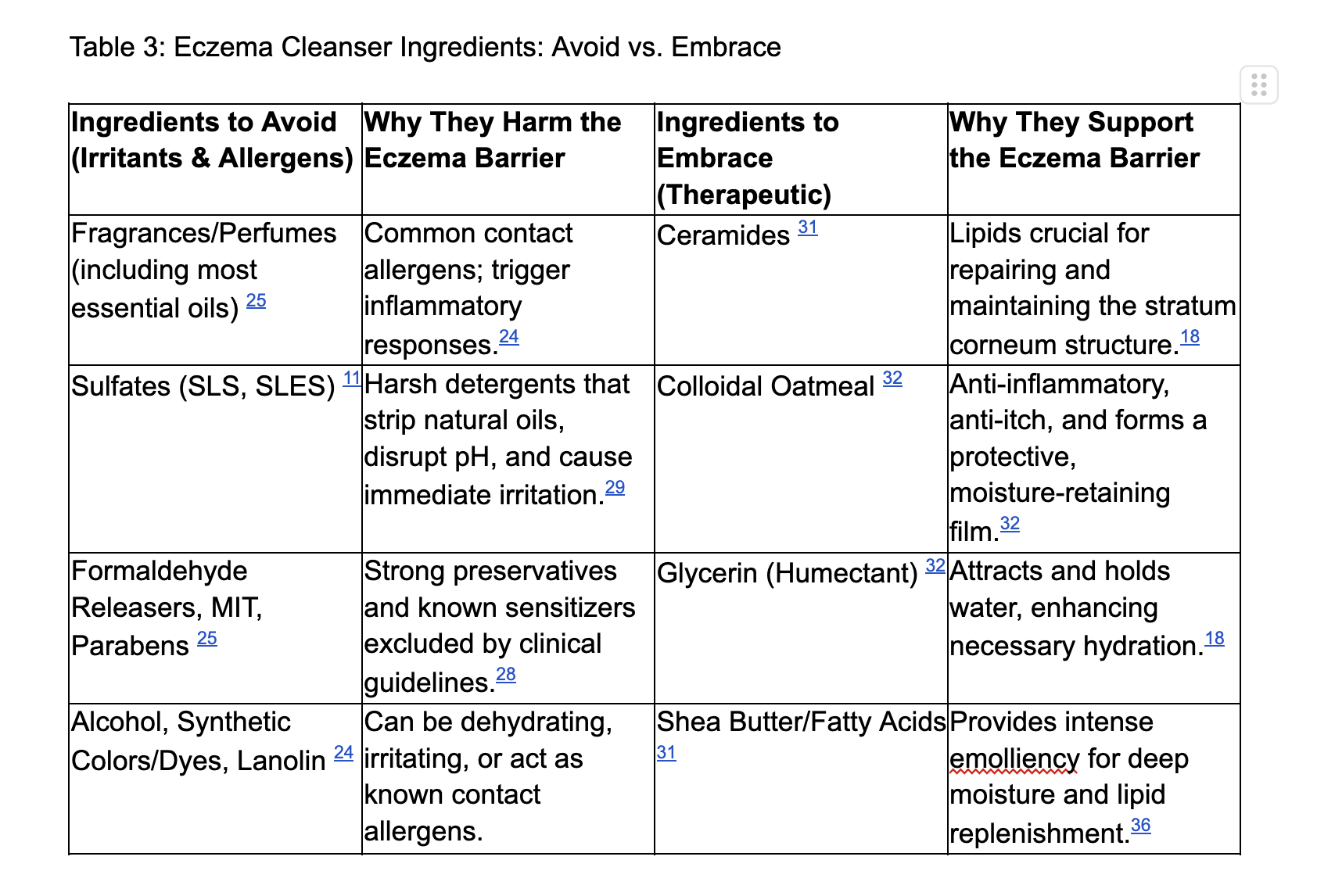
Fragrances and Perfumes: This is the primary trigger category to eliminate. Fragrances (including synthetic perfumes and many essential oils) are common contact allergens found widely in skincare and household products, and they significantly increase the risk of initiating eczema flares.24
Sulfates (SLS and SLES): Sodium Lauryl Sulfate (SLS) and Sodium Laureth Sulfate (SLES) are harsh foaming agents.29 They function as aggressive detergents that strip away essential natural oils, drastically raise skin pH, and are known severe irritants.11 Make sure any body wash or shampoo is clearly sulfate-free.29
Preservatives: Certain preservatives are notorious sensitizers and irritants. These include formaldehyde-releasing agents, specific parabens (e.g., methylparaben, propylparaben), and Methylisothiazolinone (MIT).11
Other Common Offenders: Other ingredients to avoid include alcohol (more than 12% ethanol can be dehydrating43), synthetic colors and dyes, propylene glycol, and Lanolin, the latter of which is a common contact allergen in AD patients.24
Barrier-Building Blocks: Ingredients to Seek
Cleansers for eczema should ideally not only clean gently but also contain components that actively support barrier repair and reduce inflammation. Below are some helpful ingredients to look for:
Ceramides: These are essential lipids, or fats, naturally found in the skin that play an important role in barrier function.31 Using cleansers formulated with ceramides helps restore the compromised "mortar" of the skin barrier, preventing moisture loss and enhancing skin health.18
Colloidal Oatmeal (Avena sativa): This highly soothing ingredient provides significant benefits for eczema-prone skin. It is finely ground oats that act as a humectant (drawing moisture into the skin) and an anti-inflammatory agent, providing relief from itching and forming a protective barrier that retains moisture and shields the skin from irritants.31
Humectants: Substances like Glycerin and Hyaluronic Acid attract and bind water to the skin, enhancing hydration.18 Glycerin, in particular, is frequently incorporated into gentle, high-quality syndet formulations.30
How to Select a Clinically Verified Cleanser
When an emollient or cleanser is labeled “for eczema”, that only indicates that it contains colloidal oatmeal and/or mineral oil [reference]. The appearance of “eczema” on the label does not indicate that the product contains any of the desired ingredients nor does it assure the absence of any of the ingredients to avoid. Parents should still read the full ingredient list for any product, even ones claiming to be “for eczema”.
Conclusions and Recommendations
Savvy parents can help their child’s skin by using products judiciously and looking for those that enhance the skin’s protective properties rather than damage its natural defenses.
Below is a quick summary of takeaways from this blog:
Ditch the Soap: Avoid harsh soaps and any product known to be highly alkaline. Luke-warm (not tepid) water alone might be enough.
Embrace the Syndet: If opting for more than water, choose only liquid, fragrance-free, pH-balanced synthetic detergents (syndets).
Target Ingredients: Seek out washes containing active barrier-replenishing ingredients such as ceramides.
Maintain Consistency: Adhere to the bathing and moisturizing routine daily, even when the skin is clear, as this proactive approach prevents subsequent flares.5
Test New Products: Always test a new product—cleanser or moisturizer—on a small patch of skin first to ensure tolerance.5
Consult a Professional: If symptoms persist or if signs of skin infection (pus, crusting, or fever) are noted, consult a pediatric dermatologist immediately.5
Pro tip: Listen to our podcast about bathing.
VI. References and Further Reading
American Academy of Dermatology (AAD). Treating babies and children with eczema.7
Noviello, et al. (2024). A comparative study on the effect of different cleansing methods on pediatric skin barrier function. Cited in Kim, et al. (2024). Bathing and atopic dermatitis: a comprehensive review of guidelines and studies. The Journal of Dermatology.4
Loden, M. (2003). The clinical benefit of a synthetic detergent (syndet) bar in patients with atopic dermatitis. Cited in Draelos, Z. D. (2024). Cleansers, moisturizers, and the skin barrier. Dermatology Times.18
American Academy of Pediatrics (AAP). (2025). Atopic Dermatitis: Update on Skin-Directed Management: Clinical Report. Pediatrics.21
Huang, Y. C., & Lee, C. H. (2024). Hydrogen-ion concentration of skin cleansers and their utility in atopic dermatitis. Annals of Allergy, Asthma & Immunology.10
Fluhr, J. W., et al. (2018). Bathing in daily routine. Cited in GPER information.16
National Eczema Association (NEA). Seal of Acceptance™ Criteria and Ecz-clusion List.25
Silverberg, J. I., et al. (2017). Association between bleach baths and reduced severity of atopic dermatitis: a systematic review and meta-analysis. Cited in Northwestern Medicine news release.8
Hon KL, et al. (2014). Emollient bath oil as an adjunct to treatment in children with atopic dermatitis: an observer-blind randomized controlled trial. Clinical and Experimental Dermatology.42
Mayo Clinic. Baby eczema: What works?.5
Parente, J., et al. (2022). Surfactants: the good, the bad and the ugly. Clinical, Cosmetic and Investigational Dermatology.13
Royal Children’s Hospital Melbourne (RCH). Skincare for babies.19
German Agency for Quality in Medicine (ÄZQ). Eczema (atopic dermatitis).36
Lee, C. H. (2022). Atopic dermatitis: The role of excess serine protease activity and the use of neutral-to-alkaline soaps. Acta Dermato-Venereologica.15
National Eczema Association (NEA). Bathing basics for eczema.1
Dermatology Times. Cleansers, moisturizers, and the skin barrier.18
Van Onselen, J. (2021). 10 common questions about eczema in little ones. Exchange 181.20
Celikoglu, M., Raab, C., Vollert, H. et al. A pilot study on the cutaneous effects of ethanol in a moisturizing cream on non-lesional skin of patients with atopic dermatitis. Sci Rep 15, 32536 (2025).43
Works cited
Bathing for Eczema - National Eczema Association, accessed October 5, 2025, https://nationaleczema.org/treatments/bathing/
Atopic dermatitis and bathing - PMC, accessed October 5, 2025, https://pmc.ncbi.nlm.nih.gov/articles/PMC8516174/
Eczema in early life: Genetics, the skin barrier, and lessons learned from birth cohort studies, accessed October 5, 2025, https://pmc.ncbi.nlm.nih.gov/articles/PMC2957505/
Bathing in Atopic Dermatitis in Pediatric Age: Why, How and When - PMC, accessed October 5, 2025, https://pmc.ncbi.nlm.nih.gov/articles/PMC10801494/
How to treat baby eczema - Mayo Clinic, accessed October 5, 2025, https://www.mayoclinic.org/diseases-conditions/atopic-dermatitis-eczema/expert-answers/baby-eczema/faq-20450999
Eczema - Self-Care Forum, accessed October 5, 2025, https://www.selfcareforum.org/eczema/
How to treat eczema in babies - American Academy of Dermatology, accessed October 5, 2025, https://www.aad.org/public/diseases/eczema/childhood/treating/treat-babies
Water baths as good as bleach baths for treating eczema - Northwestern Now, accessed October 5, 2025, https://news.northwestern.edu/stories/2017/november/bleach-baths-eczema
Best Soap for Atopic Dermatitis: Ingredients To Look For and To Avoid | MyEczemaTeam, accessed October 5, 2025, https://www.myeczemateam.com/resources/best-soaps-for-eczema-your-guide
Not all marketed skin cleansers' pH is optimal for atopic dermatitis - PubMed, accessed October 5, 2025, https://pubmed.ncbi.nlm.nih.gov/38982600/
8 Products To Avoid With Seborrheic Dermatitis - MySebDermTeam, accessed October 5, 2025, https://www.mysebdermteam.com/resources/products-to-avoid-with-seborrheic-dermatitis
Urology & Continence Care Today - Article: Skin pH and barrier function, accessed October 5, 2025, https://www.ucc-today.com/journals/issue/launch-edition/article/skin-ph-and-barrier-function
Skin Cleansing without or with Compromise: Soaps and Syndets - PMC, accessed October 5, 2025, https://pmc.ncbi.nlm.nih.gov/articles/PMC8954092/
Skin Barrier Integrity and Natural Moisturising Factor Levels After Cumulative Dermal Exposure to Alkaline Agents in Atopic Dermatitis | HTML | Acta Dermato-Venereologica, accessed October 5, 2025, https://www.medicaljournals.se/acta/content/html/10.2340/00015555-1815
Abnormal skin barrier in the etiopathogenesis of atopic dermatitis - PMC, accessed October 5, 2025, https://pmc.ncbi.nlm.nih.gov/articles/PMC2852024/
Cleansers, Moisturizers, and the Skin Barrier | Dermatology Times, accessed October 5, 2025, https://www.dermatologytimes.com/view/cleansers-moisturizers-and-the-skin-barrier
Kids Health Info : Skincare for babies - The Royal Children's Hospital, accessed October 5, 2025, https://www.rch.org.au/kidsinfo/fact_sheets/Skincare_for_babies/
Babies and eczema, accessed October 5, 2025, https://eczema.org/information-and-advice/information-for-parents-and-children/babies-and-eczema/
Atopic Dermatitis: Update on Skin-Directed Management: Clinical Report | Pediatrics, accessed October 5, 2025, https://publications.aap.org/pediatrics/article/155/6/e2025071812/201952/Atopic-Dermatitis-Update-on-Skin-Directed
Choosing the Best Soap for Your Child With Eczema | MyEczemaTeam, accessed October 5, 2025, https://www.myeczemateam.com/resources/choosing-the-best-baby-soap-for-eczema
1% Colloidal Oatmeal Cream/Baby Wash Regimen Improved Atopic Dermatitis in Pediatric Patients From First Use - PubMed, accessed October 5, 2025, https://pubmed.ncbi.nlm.nih.gov/41037526/
A Comprehensive Review of the Treatment of Atopic Eczema - PMC, accessed October 5, 2025, https://pmc.ncbi.nlm.nih.gov/articles/PMC4773205/
The Ecz-clusion List - National Eczema Association, accessed October 5, 2025, https://nationaleczema.org/eczema-products/the-ecz-clusion-list/
Seal of Acceptance™ Home - National Eczema Association, accessed October 5, 2025, https://nationaleczema.org/eczema-products/seal-home/
Seal of Acceptance™ Criteria - National Eczema Association, accessed October 5, 2025, https://nationaleczema.org/eczema-products/seal-of-acceptance-criteria/
What Ingredients Should NOT Be in Your Skincare Products - Premier Dermatology, accessed October 5, 2025, https://www.premierdermde.com/blog/what-ingredients-should-not-be-in-your-skincare-products
6 Essential Products for Eczema and Why They Work, accessed October 5, 2025, https://nationaleczema.org/blog/6-essential-products-and-ingredients-for-eczema/
Role of Actives in Emollients in Atopic Dermatitis - Journal of Dermatology and Skin Science, accessed October 5, 2025, https://www.dermatoljournal.com/articles/role-actives-emollients-atopic-dermatitis.html
Learn More – Skin care for eczema - InformedHealth.org - NCBI, accessed October 5, 2025, https://www.ncbi.nlm.nih.gov/books/NBK424900/
About the Seal of Acceptance™ | National Eczema Association, accessed October 5, 2025, https://nationaleczema.org/eczema-products/about-nea-seal-of-acceptance/
Eczema and Body Wash: Ingredients, Brands, and Other Considerations | MyEczemaTeam, accessed October 5, 2025, https://www.myeczemateam.com/resources/eczema-and-body-wash-ingredients-brands-and-other-considerations
Best body wash for baby eczema? : r/beyondthebump - Reddit, accessed October 5, 2025, https://www.reddit.com/r/beyondthebump/comments/1j85qp5/best_body_wash_for_baby_eczema/
Emollient enhancement of the skin barrier from birth offers effective atopic dermatitis prevention - PMC - PubMed Central, accessed October 5, 2025, https://pmc.ncbi.nlm.nih.gov/articles/PMC4180007/