Best Natural Eczema Treatments & OTC Breakthroughs: Expert Advice for Parents

If your child is battling eczema, your daily routine probably feels like a frustrating cycle of applying prescription steroid creams, worrying about side effects, and waiting for the next itchy flare-up to strike.
But what if some of the most exciting breakthroughs in eczema care aren't found in a prescription bottle? What if they are waiting right in the over-the-counter (OTC) aisle, in the microscopic world of your child's skin bacteria, or even at your local park?
In the latest episode of the Eczema Breakthroughs podcast, host Korey Capozza, Executive Director of Global Parents for Eczema Research (GPER), sat down with leading pediatric eczema expert Dr. Peter Lio. As the director of the Chicago Integrative Eczema Center, Dr. Lio bridges the gap between traditional medicine and natural therapies.
In this episode, Dr. Lio shared why new advances in non-prescription strategies are becoming the ultimate frontline defense for modern eczema care. Here are the top four parent-friendly takeaways to help heal your child’s skin.
1. Look Beyond Regular Soap: The Power of Eczema Cleansing Oils
Many parents know they need to avoid harsh, fragrance-heavy soaps. However, Dr. Lio points out that just finding a "gentle" soap isn't enough anymore. The newest strategy is to use cleansers that actively put moisture back into the skin while washing.
He is a huge advocate for oil-based body washes and cleansers for kids with sensitive skin.
"I’m really a big fan of oil-based cleansers because I think not only are they gentle... but these actually add oil and add good things to your skin, good fats and lipids that really help rebuild it."
The Parent Takeaway: Switch from standard "sensitive skin" liquid soaps to an oil-based eczema cleanser. It cleanses without stripping away the skin's natural oils, acting as a first layer of defense during bath time.
If you’re curious about the best optimal bathing procedures by age, check out our Bathing blog.
2. How to Find the Best Eczema Lotion for Kids (Without the Tears)
Finding a moisturizer that doesn't sting or feel "gross" to a toddler or child can be an uphill battle. If a child hates the lotion, they will fight you every time you try to apply it.
Dr. Lio emphasizes that the most expensive cream isn't necessarily the best. The "best" cream is the one your child actually likes to wear. To stop the lotion battles, he lets the child take control of the choice:
"My favorite thing, I get a lot of kids who maybe don’t like moisturizers at all or have had bad experiences, and I’ll come in with a pallet of moisturizers and I’ll say, 'Why don’t we try these together?'... When they find one that they like, that can be a magical moment where they say, 'Oh. I like this one. This is my moisturizer.'"
The Parent Takeaway: Buy a few travel-sized, eczema-safe lotions and creams. Sit down with your child and let them test them on a small patch of skin to "vote" on their favorite. Giving them a choice turns a chore into team work.
Our podcast on Smarter Skin Care, reveals the moisturizers preferred by researchers.
3. Balancing the Skin's "Microbiome" (The Good Bugs vs. Bad Bugs)
Scientists now know that healthy skin is covered in trillions of microscopic, friendly bacteria—called the skin microbiome. In children with eczema, the bad bacteria (specifically one called Staph) completely take over, causing intense itching, redness, and cracked skin.
Dr. Lio explained that treating eczema means we have to stop treating Staph as a minor byproduct and start treating it as a root cause:
"In the old days, I was taught it’s just an opportunistic infection, a colonizer. But now we go, oh my gosh, this really has multiple ways that it’s directly damaging the barrier, directly driving itch, directly driving inflammation... So I do think that’s gonna be important."
The exciting news? Researchers are currently developing topical probiotics—creams containing healthy bacteria—that selectively kill off the bad Staph bugs while protecting the skin's natural ecosystem. For a deep dive into the effects of Staph on eczema check out Staph’s secret super power or Eradicating Staph podcasts.
The Parent Takeaway: The future of eczema care is about supporting the skin's ecosystem, not just wiping out all bacteria with heavy antibiotics. Keep an eye out for microbiome-friendly over-the-counter products.
4. "Green Space" Therapy: Why Nature is Natural Eczema Medicine
Can playing outside actually heal your child's skin? Yes! Our modern, indoor lifestyles expose us to urban pollution, car exhaust, and indoor chemicals that can break down the skin barrier.
Dr. Lio highlighted a fascinating study showing that children who spend more time in "green spaces"—like parks, forests, and grassy fields—have a much lower risk of developing eczema.
"We're meant to be outdoors, we're meant to be in these environments... What an amazing, amazing health initiative would it be to say, 'Hey, we got to get these kids outside, we got to have more green spaces, we can’t just live in a kind of a toxic modern wasteland where everybody’s locked inside all the time breathing recycled [air].'"
The Parent Takeaway: Make "nature time" a part of your weekly eczema management routine. Fresh outdoor air and exposure to natural environments help build a stronger immune system and a healthier skin barrier.
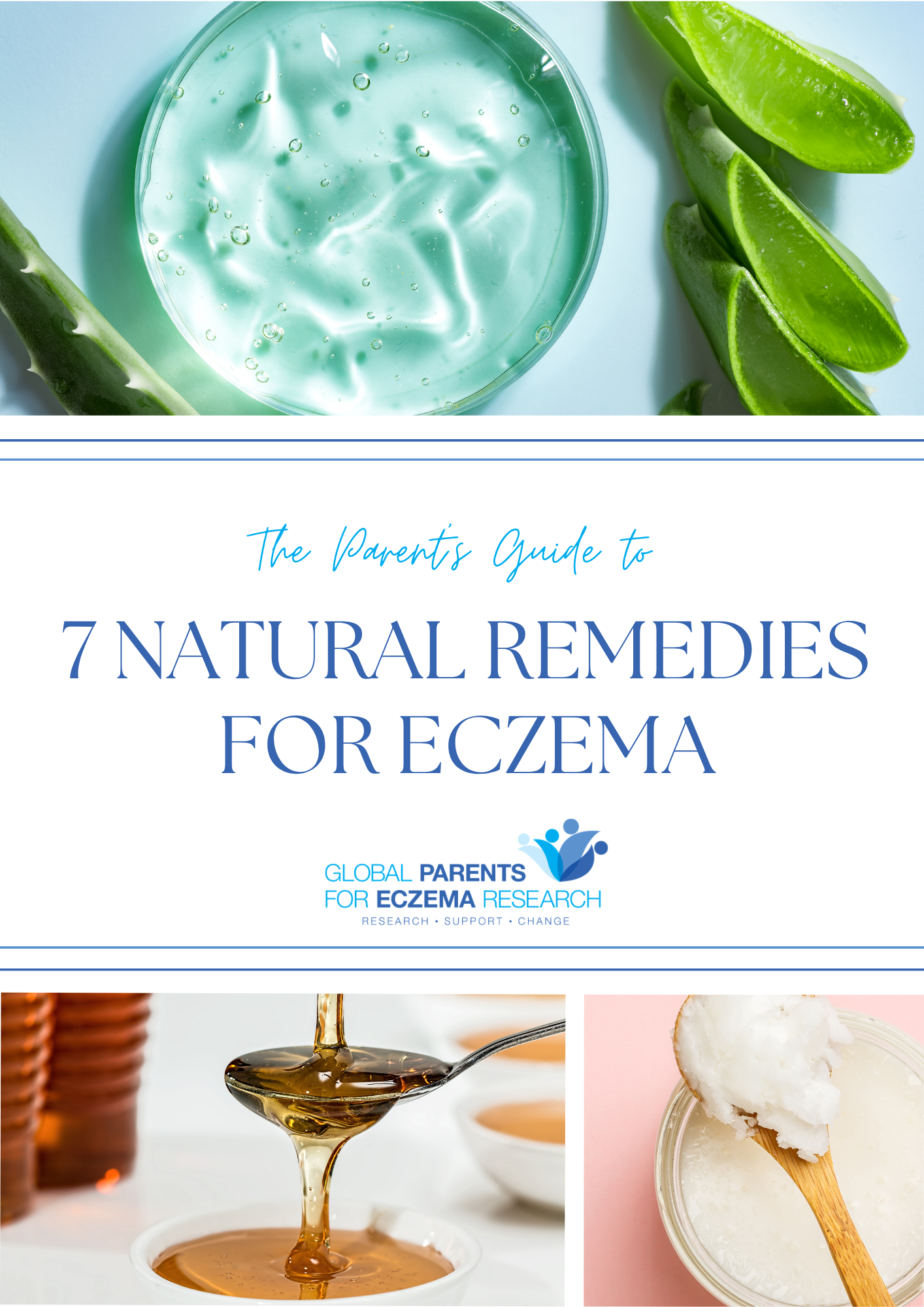
Download our Natural Remedies Guide to help cure eczema naturally.
Want to listen to the full episode?
Hear the complete, parent-friendly conversation on natural eczema remedies and cutting-edge research by tuning into the Eczema Breakthroughs podcast at www.gper.org/podcast.
eczma / exczema / exema