Does baby eczema lead to food allergies?

Food allergies affect around 1 in 10 children — but if your child has moderate to severe eczema, that risk jumps to 1 in 3. Not surprisingly, the link between eczema and food allergy isn't coincidental and eczema may even be causal.
If a baby’s skin barrier is damaged by eczema, food allergens can interact with the developing immune system before a child ever eats them. This explains why babies can react to a food the very first time they eat it: The immune sensitization may have already happened through the skin.
"Eczema is the single strongest risk factor for the development of food allergy. The earlier eczema starts and the worse it is and the higher your risk," says Dr. Vickery, Chief of Allergy and Immunology and Director of the Food Allergy Program at Children's Healthcare of Atlanta.
Why is it important to get on top of eczema early?
Eczema appears to be the starting point of the allergic march. Treating it aggressively early matters more than most parents realize. "Eczema is often the very first sign early in life that your child may be destined for other allergic diseases to come. Our focus should be on preventing the development of eczema in early life, because that seems to be where it's all starting," shares Dr. Vickery.
How can I protect my eczema baby from food allergies before introducing foods?
If you want to give your baby the best chance of avoiding a food allergy, this is what the experts recommend:
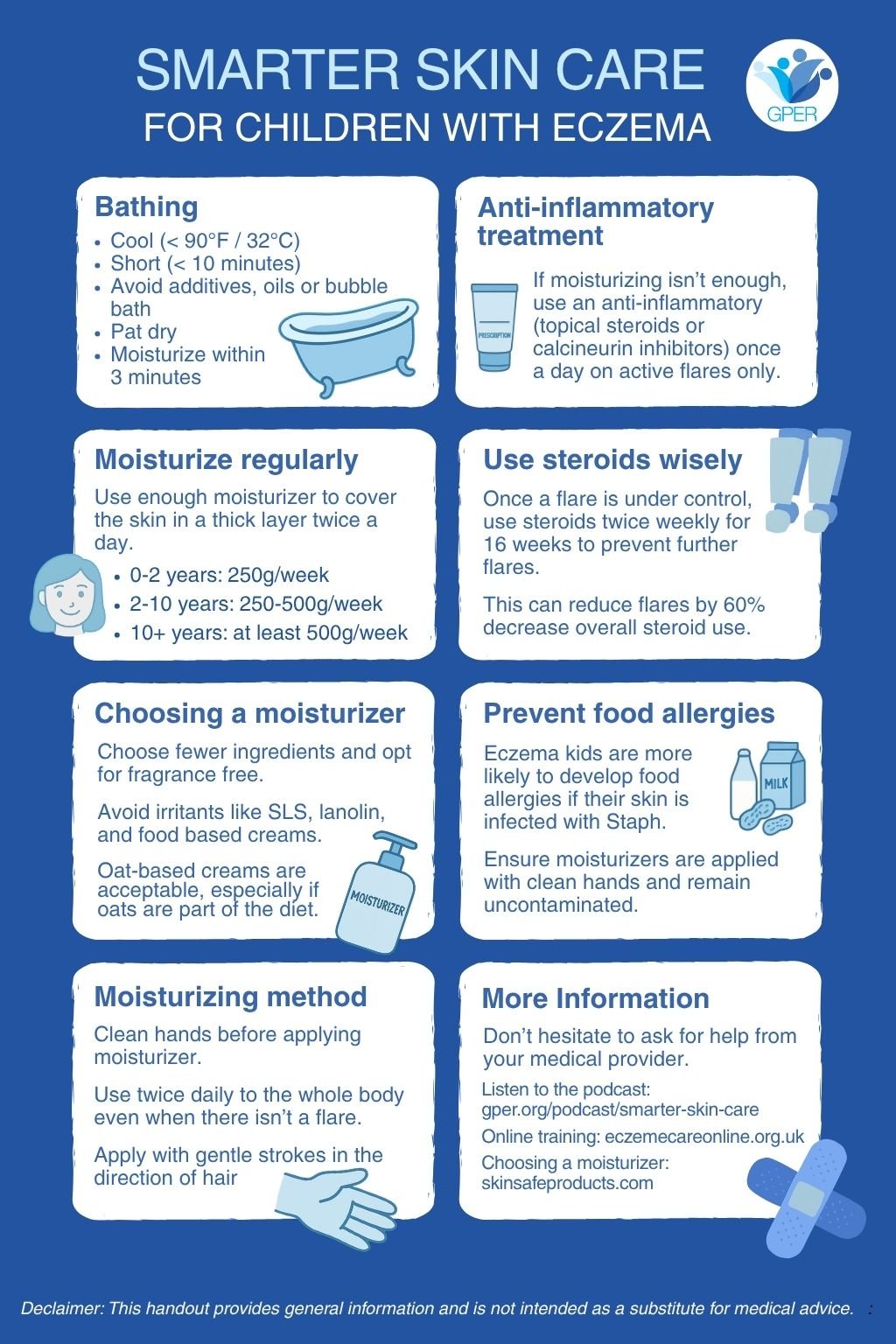
Treat the eczema immediately, moisturize after a bath, use topical steroids or other prescription medication to calm the skin during flares and develop a relationship with your primary care provider.
Wash hands thoroughly with soap and water before touching baby.(alcohol sanitizers don't remove allergens).
Using a spoon rather than your hand to dip into a pot of emollients.
Keep mealtime prep and eating separate from skin care time for baby.
How to introduce allergenic foods to babies, especially with eczema
For decades, the advice was to delay allergenic foods. That guidance has now been completely reversed. "That was a well-intentioned but completely unscientific idea," Dr. Vickery explains. In fact babies with moderate to severe eczema that are introduced to allergens from around five months of age have much lower rates of food allergy compared to those who avoided them. Here is the current advice for parents:
Breastfeed as long as possible; breastfeeding mothers do not need to restrict allergenic foods from their diet
Introduce grains first between four to six months, eg. powdered rice or oatmeal. No grains before four months.
Follow grains with mashed or pureed fruit and veg
Once baby handles purees, begin introducing potential allergens around four to five months
Egg: hard boil for 10–12 minutes, mash into a paste, and mix with a food baby already likes
Peanut: mix some smooth peanut butter into a familiar food.
Aim for at least one teaspoon of egg or peanut, at least three times a week.
Dr. Vickery recommends that we move away from this idea that you just give baby a little bit of an allergen once because that might not be enough to teach the body that this allergen is normal.
Learn more about link between the food allergy and eczema
What can I do if my child already has a food allergy? Oral Immunotherapy (OIT)
For children who have already developed a food allergy, a treatment called oral immunotherapy (OIT) is increasingly available and can be life-changing. Oral immunotherapy treats the allergy by exposing the patient to small amounts of the thing they're allergic to. It actually changes the immune response and addresses the root cause of the problem.
What is the benefit and limitation of OIT?
OIT is not a cure. Rather, it creates desensitization (the process of making someone less sensitive or reactive to a stimulus through repeated exposure): enough protection that accidental exposures are far less likely to cause a severe reaction. Despite all those precautions, patients do experience reactions because accidents are inevitable. OIT is designed to protect people from those accidents.
What’s involved in OIT?
Patients start with a tiny dose of their allergen (such as peanut protein) under medical supervision, once it’s deemed safe, they then take it daily at home. Over time the dose is gradually increased and the process is repeated until reaching a "maintenance dose", roughly the equivalent of one peanut kernel. If somebody can get through that up-dosing ladder to their maintenance dose, the studies show that a very high percentage of them are protected from large exposures.
Starting young matters
When OIT is started in the first year or two after diagnosis, the odds of achieving remission — where the allergy becomes much less active — can be as high as 50–80%. However, when it’s used in an 8 or 10 or 15-year-old, the odds of remission are much, much lower."
Other treatments on the horizon: SLIT and EPIT
Beyond OIT, two other forms of immunotherapy are in development:
SLIT (Sublingual Immunotherapy): A small dose held under the tongue rather than swallowed. A sublingual tablet is currently in clinical trials.
EPIT (Epicutaneous Immunotherapy): Also known as the “peanut patch”. A sticker, about the size of a coin, delivers a tiny dose through the skin. The peanut patch has shown positive results in children aged 4–7 and is awaiting regulatory approval, with trials underway in children aged 1–4.
Learn more: Are food allergies forever?
Key Takeaways for Parents
Treat eczema aggressively and early — it may be the gateway to food allergy
Minimize allergen contact with baby's skin before they are ready to for food introduction
Introduce allergenic foods early (around 4–6 months) and regularly — don't do it once and stop
If food allergy develops, ask your allergist about OIT — especially if your child is young.