Spot the Difference: Eczema vs. 5 Common Skin Mimickers
As parents and caregivers, finding a new red bump, patch, or rash on your child can be cause for concern. More so, because it’s hard to know if it’s something serious or a temporary change that is nothing to worry about. If your child has a history of eczema (atopic dermatitis), it’s easy to assume that every skin flare-up is just another eczema episode.
However, children’s skin is prone to a wide variety of overlapping conditions, and treating the wrong one can delay healing or lead to other problems. Globally, atopic dermatitis peaks in childhood and affects over 171 million people, but it frequently coexists with or looks a lot like other common childhood rashes.
In this blog we’ll empower you with evidence-based knowledge to help you differentiate between eczema and five of its most common look-alikes: impetigo, scabies, diaper rash, heat rash, and hives.
(For more information on treating and managing eczema, check out our parent’s guide to eczema treatments or enroll in our parent support program!)
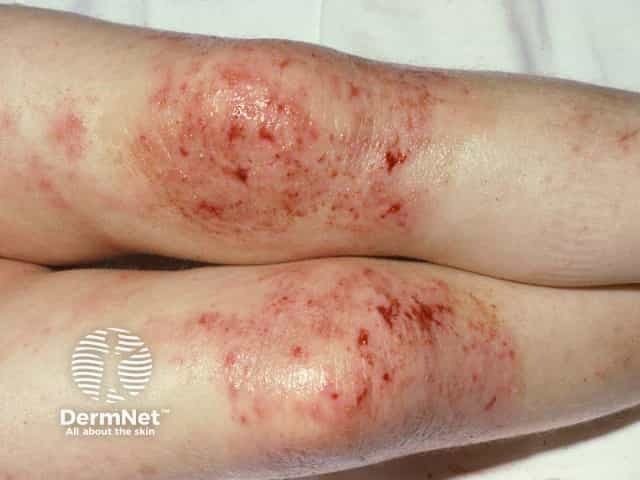
Eczema (Atopic Dermatitis) reddened inflammation on child’s knees and legs, bleeding and darkened areas
1. Eczema vs. Impetigo: The Bacterial Intruder
Because eczema compromises the skin barrier, it leaves children highly susceptible to secondary bacterial infections. The most common complication is impetigo, which is predominantly caused by Staphylococcus aureus or Streptococcus pyogenes.
Impetigo appears as dry, red, scaly, or leathery patches. Poorly defined edges with fine scaling (Udkoff et al., 2023).
Begins as small red sores/blisters that break open and leave yellow honey-like crusts (Nardi et al., 2023).
Where does impetigo appear?
Impetigo is most commonly seen around the nose, face, legs and arms (Nardi et al., 2023). In contrast, eczema usually appears on the face of babies and in the elbow and knee creases in older children (Wollenberg et al., 2023).
What are the symptoms of impetigo vs. eczema?
Impetigo is mildly itchy and painful, but typically not as intensely itchy as eczema (Nardi et al., 2023).
Key Research Clue: If an eczema patch suddenly worsens, oozes pus, or develops a yellowish "stuck-on" crust, it has likely evolved into eczema infected by bacteria. This requires topical or oral antibiotic therapy rather than just increasing your child's standard eczema treatments.
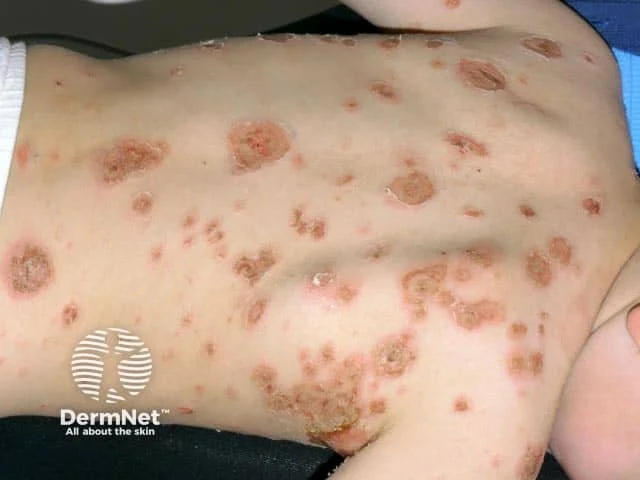
Impetigo, large blistering sores along child’s back, crusting and inflammation
2. Eczema vs. Scabies: The Bugs that Itch
Scabies is an intense parasitic infestation caused by microscopic mites that burrow into the skin. Because both eczema and scabies present with widespread red bumps and severe itching, they are frequently confused (Kang et al., 2021).
Look for the Burrows: Scabies mites tunnel just under the skin. Clinicians look for tiny, silver-gray, linear tracks (burrows) on the skin's surface.
The Webbing Habit: While baby eczema typically favors the face, neck, and joint creases, scabies has a strict preference for the webbing between fingers and toes, inner wrists, armpits, and the waistline (Wollenberg et al., 2023). In infants, scabies can uniquely affect the palms of the hands and soles of the feet.
The Nighttime Clue: While eczema can certainly disrupt sleep, the itching associated with scabies becomes overwhelmingly, distinctively intense at night.
The Cluster Phenomenon: Scabies is highly contagious through direct skin-to-skin contact. If multiple family members or close contacts develop an intense itch simultaneously, scabies is highly probable.
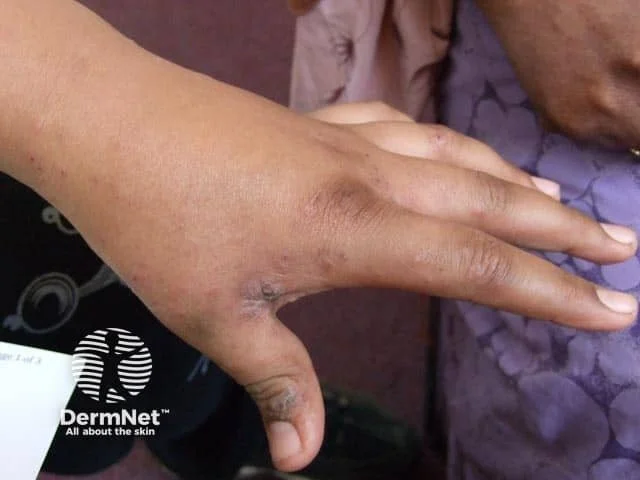
Scabies, hyperpigmentation (darkened) small wavy lines and spots
Where does scabies appear?
Scabies usually shows up between fingers, wrists, elbows, armpits, waist, buttocks, groin; face, scalp, palms, and soles of feet are also common areas in infants (Sunderkötter et al., 2021).
3. Eczema vs. Diaper Rash: Location is Everything
Diaper dermatitis (also known as irritant diaper rash or nappy rash) is an inflammatory reaction triggered by prolonged contact with moisture, friction, and urine/feces.
The Sparing of the Folds: Classic irritant diaper rash highlights the areas of direct contact with the diaper but typically spares the deep skin folds and creases. Conversely, if the rash is bright red and thrives deep within the folds, it may be a secondary yeast infection (Candidiasis).
Eczema is Rarely Isolated Here:Eczema rarely targets the diaper area exclusively in infants. In fact, the localized humidity trapped within a diaper often keeps the skin hydrated, acting as a natural shield against the dryness that drives atopic dermatitis. If a rash is isolated strictly to the diaper zone, look toward diaper dermatitis rather than eczema.
Appearance
Eczema: Dry, red, scaly, or leathery patches. Poorly defined edges with fine scaling (Udkoff et al., 2023).
Diaper Rash: Bright red, inflamed patches in the diaper area. Skin may appear shiny or mildly scaly; severe cases may appear raw (Ojeda et al., 2023).
Sensation
Eczema: Pruritus (intense itching) is a mandatory diagnostic feature (Wollenberg et al., 2023).
Diaper Rash: Mild discomfort, soreness, or burning; itching is variable and generally less intense than eczema (Ojeda et al., 2023).
4. Eczema vs. Heat Rash: The Sudden Summer Flare
Heat rash, clinically known as miliaria, occurs when sweat ducts become blocked, trapping sweat beneath the skin surface. It is incredibly common in infants due to their underdeveloped sweat glands and tendency to be over-bundled.
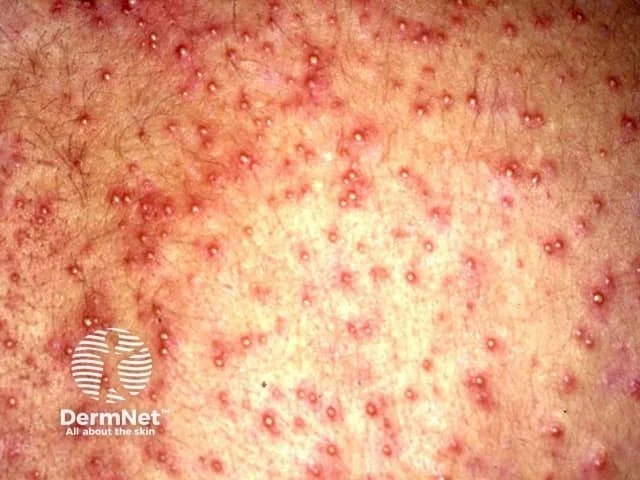
The Appearance: Heat rash most commonly presents as miliaria rubra, consisting of a sudden crop of tiny, pinpoint red bumps that carry a sharp, prickling sensation. Eczema forms much larger, cohesive, poorly defined plaques with visible dryness and scaling (Udkoff et al., 2023).
Speed of Onset and Resolution: Heat rash appears rapidly during hot, humid weather or intense physical activity. Crucially, it usually resolves within a few days simply by moving the child into a cool environment and keeping the skin dry. Eczema flares are chronic, lasting weeks or months without targeted barrier-repair therapy.
Common Spots: Heat rash strictly targets areas with dense sweat glands or friction from clothing, such as the neck, chest, upper back, and skin folds
For more information about how climate affects eczema, listen this eczema podcast.
What does heat rash look like?
Heat rash usually appears as many small (1-4mm) red or clear swelling bumps that look like tiny blisters and have a prickly appearance. Often occurs in clusters after sweating or overheating.. It’s usually found in areas which are prone to sweat or tight clothing such as the neck, chest, back, armpits, groin (Guerra et al., 2024).
What does heat rash feel like?
Generally heat rash is an itchy, prickly, sensation of tiny needles, worsens when sweating or exposed to high temperatures (Guerra et al., 2024).
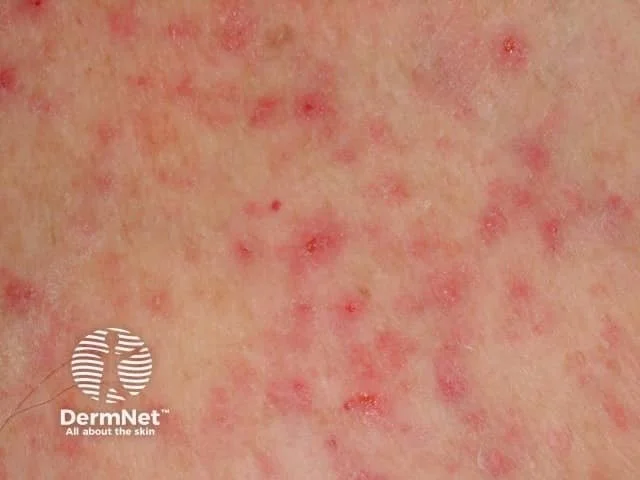
Milaria, small red bumps which may be itched open, on light skin
Milaria, small red bumps which may be itched open, on medium tone skin
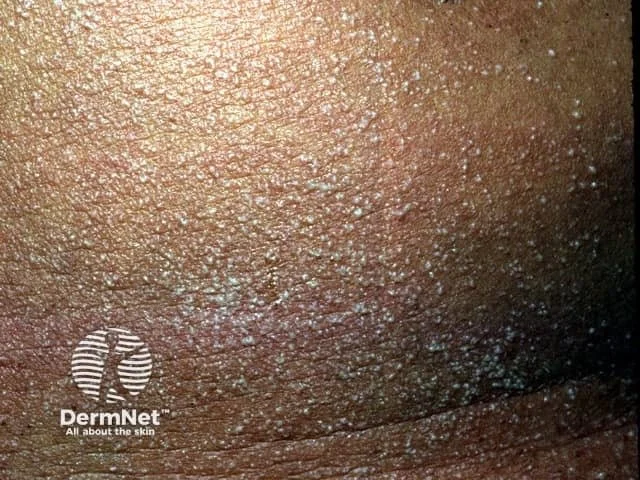
Milaria, small white bumps which may be itched open, on dark skin
5. Eczema vs. Hives (Urticaria): The Shape-Shifter
Hives are an acute, transient skin reaction driven by mast cell activation, often triggered by viral infections, food allergens, or environmental exposures.
Transient Nature (The 24-Hour Rule): This is the ultimate differentiator. An individual hive (wheal) is fleeting; it will appear, expand, and completely disappear or migrate to a new part of the body within 24 hours. Eczema patches are stationary and persistent, remaining fixed in the same location for long stretches.
The Visual Fingerprint: Hives present as raised, swollen, smooth welts with a blanched (pale) center and a red outer ring. Eczema lesions are flat or slightly raised, rough, dry, and frequently show scratch marks.
Onset: Hives develop within minutes to hours of exposure to a trigger, whereas eczema flares build up more gradually.
What does urticaria look like?
Hives/urticaria are typically raised, swollen bumps or welts that may appear pink, red, or skin toned, often changing shape or moving around the body within hours (Ben-Shoshan et al., 2024). They can occur anywhere on the body and often migrates from one area to another over hours (Ben-Shoshan et al., 2024). In contrast, eczema typically appears in the face in babies and arm/leg creases of older children.
Urticaria hives can be Intensely itchy, bumps and may move or disappear and reappear within a day (Ben-Shoshan et al., 2024).
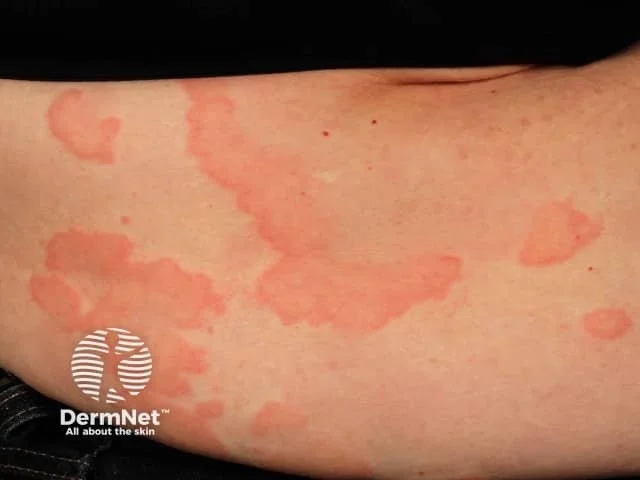
Urticaria, asymmetrical red shapes with more intensely pigmented borders
Side note: This list is not exhaustive and other common atopic eczema mimickers include:
For more information on treating and managing eczema, check out our parent’s guide to eczema treatments or enroll in our parent support program!
When to Call the Doctor
Seek immediate medical attention if your child's rash is accompanied by:
A high fever, lethargy, or general malaise.
Signs of systemic bacterial infection, such as rapid spreading, intense pain, significant swelling, or red streaks traveling from the rash.
Blistering that covers large areas of the body.
Swelling of the lips, tongue, or face, or any difficulty breathing (signs of a life-threatening anaphylactic allergic reaction).
References
Guerra KC, Toncar A, Krishnamurthy K. Miliaria. [Updated 2024 Sep 1]. In: StatPearls [Internet]. Treasure Island (FL): StatPearls Publishing; 2026 Jan-. Available from: https://www.ncbi.nlm.nih.gov/books/NBK537176/
Kang, S. Y., Um, J. Y., Chung, B. Y., Kim, J. C., Park, C. W., & Kim, H. O. (2021). Differential Diagnosis and Treatment of Itching in Children and Adolescents. Biomedicines, 9(8), 919.https://doi.org/10.3390/biomedicines9080919Cited by: 14
Nardi NM, Schaefer TJ. Impetigo. [Updated 2023 Jul 31]. In: StatPearls [Internet]. Treasure Island (FL): StatPearls Publishing; 2026 Jan-. Available from: https://www.ncbi.nlm.nih.gov/books/NBK430974/
Benitez Ojeda AB, Mendez MD. Diaper Dermatitis. [Updated 2023 Jul 3]. In: StatPearls [Internet]. Treasure Island (FL): StatPearls Publishing; 2026 Jan-. Available from: https://www.ncbi.nlm.nih.gov/books/NBK559067/
Siegfried, E., & Hebert, A. (2015). Diagnosis of Atopic Dermatitis: Mimics, Overlaps, and Complications. Journal of Clinical Medicine, 4(5), 884-917.https://doi.org/10.3390/jcm4050884Cited by: 198
Ben-Shoshan, M., Kanani, A., Kalicinsky, C., & Watson, W. (2024). Urticaria. Allergy, asthma, and clinical immunology : official journal of the Canadian Society of Allergy and Clinical Immunology, 20(Suppl 3), 64. https://doi.org/10.1186/s13223-024-00931-6
Sunderkötter, C., Wohlrab, J., & Hamm, H. (2021). Scabies: Epidemiology, Diagnosis, and Treatment. Deutsches Arzteblatt international, 118(41), 695–704. https://doi.org/10.3238/arztebl.m2021.0296
Udkoff, J., Borok, J., Vaida, F., Tang, B., Matiz, C., Ahluwalia, J., Russell, E., & Eichenfield, L. (2023). Assessment of the American Academy of Dermatology diagnostic criteria for pediatric atopic dermatitis and modification into a checkbox form: A cross‐sectional study. Pediatric Dermatology, 40(5), 809-815.https://doi.org/10.1111/pde.15338Cited by: 6
Wollenberg, A., Werfel, T., Ring, J., Ott, H., Gieler, U., & Weidinger, S. (2023). Atopic dermatitis in children and adults. Deutsches Ärzteblatt international.https://doi.org/10.3238/arztebl.m2023.0011Cited by: 148
Disclaimer: This article is for educational purposes and is not a substitute for professional medical advice, diagnosis, or treatment.